Thursday, January 16, 2014

Parking

I was back at the Pine Brook Conservation area today with my camera. I noticed bright green moss, the only colorful thing among the brown leaves, grey bark and gloomy sky. There were puffball mushrooms along the trail spreading their spores with the slightest jostle. There was fragile ice along the shore. I saw the bottom half of a mouse on top of a broken stump. The raptor with the other half was no where to be seen.

I went to take pictures of some out-of-place Americana turned to sculpture: a jumble of old, rusted cars at the bottom of a ridge. I'll have to investigate how they got there. It will be a new urban myth or ghost story.

Please leave a comment if you can identify the make, model and year of these fine vehicles.


Friday, January 10, 2014

2013 Book List

Here's my 2013 book list. You can see 2012 here and 2011 here.


It was a rather unsatisfying year of reading. There were few books I loved. I read many books for my book group. The ladies tend to choose light, short novels. I also read some YA books for library work. Some of them can be well written, but they are generally about young people, young romance and problems that generally get resolved happily by the end of the book.

The books I enjoyed most over the year were ones I chose for their literary awards or because I had enjoyed the author's work previously. I also read more memoirs and diaries. I tend to get the most inspiration from women who, like me, struggle to find and distinguish themselves amidst the (in my case self-imposed) pressures to care for family.

The books I liked best this year are:
  1. People of the Book by Geraldine Brooks
  2. Telegraph Avenue by Michael Chabon
  3. The Orphan Master's Son by Adam Johnson
  4. Dreamer by Pam Munoz Ryan/Sis Neruda

People of the Book was not my favorite Geraldine Brooks novel, but it had a very interesting structure and wonderful writing. The main character was a selfish young woman who had very little appeal. Luckily her part was short. The real primary driver of the story was a book, an illustrated Passover Haggadah. The novel traced how the book was created. It followed the book back through time and told the story of the silversmith who made the clasps, the book binder, the calligrapher, and the illustrator of the remarkable codex. In each time period from the Middle Ages through modern history the book is a witness to prejudice between sexes, races and religions, primarily antisemitism. The book serves to make a bridge between the hostile parties.

I listened to Telegraph Avenue on CD, and the amazing voice of the actor who read the story may have swayed me to love it. I find reading and listening to books to be quite a difference experience. So while I here endorse the audio, I don't know how it would read on the page. The novel is a mess of complicated characters and family dynamics. There are 2 couples (or maybe 4) because the 2 husbands work together (at a failing record store), as do the 2 wives (in their own midwife practice). So there are relationships between the men, the women, the couples and their teenage children. The relationships are complicated and tender. There are a lot of plot twists, smart language and a satisfying conclusion.

The Orphan Master's Son was definitely the best book I read this past year. I picked it because it won the Pulitzer in 2012. I had never read a book like it before. It was a sweeping novel about a North Korean man who holds many jobs and plays many roles: kidnapper, signal operator, spy, prisoner, husband, father. Usually I would be turned off knowing I was going to read about prisons, torture, and hunger. But somehow, this novel came to the edge of horror and turned it into beauty. A man being tortured was able to sink deep inside himself and block pain with his memories and hopes. A man seemingly played with his children while, without their awareness, teaching them skills they would need to survive under the harshest conditions. A story of the severest deprivation and pain somehow was also a story of love, and sacrifice and hope. Read this book!

Finally on a lighter note, I'll recommend The Dreamer. It is meant for a young audience, perhaps for 4th to 6th graders. But like much of the best literature for the young, it is beautiful and inspirational for all ages. The text is by Pam Munoz Ryan, and the integral illustrations are by Peter Sis. The book is a small biographical novel about the poet, Pablo Neruda. Both the text and the illustrations are playful and charming. Like Neruda's book of questions, this book is full of questions like, "Which is sharper? the hatchet that cuts down dreams? or the scythe that clears a path for another?" The book is the journey of a young man escaping a fearful childhood and finding himself through his love of language. One fanciful vignette has the young poet taking slips of paper, on which he writes compelling words, out of his desk drawer and scattering them on the floor to make poetry. Some of the words are puma, liana, oregano, locomotive and chocolate.


The rest of my list:

1. Virginia Lee Burton, A Life in Art by Barbara Elleman (YA)
2. Life at home in the 21st Century by Jeanne Arnold
3. War Within and Without (1939-44) by Anne Morrow Lindbergh
4. Bring Me a Unicorn (1922-28) by Anne Morrow Lindbergh
5. Light Between the Oceans by M.L. Steadman
6. The language of Flowers by Vanessa Diffenbaugh
7. The Good House by Anne Leary
8. Anne Morrow Lindbergh, Her Life by Susan Hertog
9. The Empire of Illusion by Chris Hedges couldn’t finish, too grim, violent,depressing
10. The Girls from Ames by Jeffrey Zaslow
11. On a Farther Shore, Rachel Carson by William Souder
12. Pomegranate Soup by Marsha Mehran
13 Always, Rachel editor Freeman intimate letters of Rachel Carson
14. Lions of Little Rock (YA) by Kristin Levine
15. Gossip of the Starlings by Nina De Gramont (YA)
16. Einstein’s Dreams by Alan Lightman
17. Robinson Crusoe by Daniel Defoe
18. The Outermost House by Henry Beston

Sunday, November 24, 2013

A Week of Thanks: An Old-Fashioned Carrot Pull


Rich organic soil yields plentiful sweet carrots.

One of the things I am most thankful for is our CSA (Community Supported Agriculture) Siena Farm. This year "our farmer" Chris was able to purchase 26 acres of land in Sudbury, Massachusetts to be conserved in perpetuity. This is not the kind of community "development" that typical banks support. Instead the money to purchase the land came from fundraising dinners, generous supporters and CSA members.


Farmer Chris walks beside the tractor that loosens the soil for easy pulling.

Our family has purchased 3 full-year shares up front to help fund the sale. We will get 48 weekly boxes per year from now until the spring of 2017. I feel like I've gotten a bargain. Instead of our money sitting in the bank hardly keeping up with inflation, we have secured 3 years of food security and wonderful health.

D takes the greens off the carrots before putting them in the bin.

This weekend CSA members were invited to help pull a huge field of carrots before today's hard frost. Between 10am and 4pm, nearly 100 members of all ages put in some time to fill storage bins throughout the field.


filled bins in alternating rows

It was wonderful getting into the field and putting our hands in the soft, rich soil. We pulled up carrots by the dozen, ripped off their green tops, wiped off the rich dirt and filled bin after bin with carrots up to 2 inches in diameter.

J drops another carrot into his almost-full bin.


R and her friend laughed the day away.

Our family filled at least 8 bins and were rewarded with a few bags for our own winter stores.


On our way home with a golden bounty.

So far we've been eating carrot sticks with every meal. And a few big carrots went into tonight's vegetarian chili. I make a great carrot and cheddar gratin. I'm sure I'll be posting more terrific carrot recipes soon.

Sunday, November 17, 2013

Cranberry Products

The day after my cranberry picking adventure was processing day. I wanted to preserve the incredible freshness of the harvest and not lose any berries to spoilage.

The first thing I did was wash and separate the berries. I had just enough for 2 recipes, a sauce I'm saving for Thanksgiving and bread loaves, one saved for Thanksgiving and one for a just-baked treat.

Here are the ingredients for the sauce: 12 oz cranberries, zest and juice of an orange, cinnamon stick, and (oops) sugar not pictured.


In a few minutes. They are on their way to being sauce.


Ta Da... in less than half an hour: Cranberry/Orange Sauce, the perfect accompaniment to my dining room wallpaper.


The breads take a bit more effort and time, mixing wet and dry ingredients then waiting for the long bake.


The bread is delicious especially warm out of the oven. The rest is frozen waiting for Thanksgiving. What a great start for holiday preparations, Cranberry Sauce and Cranberry Bread with local berries picked by my own hands.

Friday, November 15, 2013

Gathering Cranberries

What a rush and pleasure to discover a new crop to harvest, especially one I haven't grown it myself. Tended only by nature at the edge of a reservoir, a bountiful harvest of cranberry is there for the diligent gatherer.

With temperatures in the high 40s and a steady breeze, a friend and I were nonetheless warmed by the strong sun and our efforts, a little walking, lots of bending and constantly moving, searching fingers.


We walked about 1/2 a mile through the forest that borders the reservoir. As we approached the water, there were lower shrubby plants. Then  we entered the swampy zone where low grasses and cranberries hug the water's edge.


This area is unusual for its varied microclimates. (Or maybe many areas would be as diverse if I crawled around in them keenly investigating large areas of ground.) There were spots where the cranberry plants were nestled among mosses. In other zones nearby, the cranberry stalks seemed to come right out of the sand. In those spots the cranberries that had fallen were well preserved and easy to collect. In some areas the picking was good, and you didn't notice how wet it was until your toes were wet and cold. Not far away, you could sit comfortably in a thick patch of cranberry and rake your hands along collecting.

Can you spy the cranberries? It's like finding Waldo in a red striped picture.

We spent 2 pleasant hours, chatting, picking and picnicking and collected 4 to 5 cups each. As usual, harvesting food yourself gives you a great appreciation for the effort it takes. Of course, the cranberries in our supermarkets are not hand harvested. Bogs are flooded and machines collect the cranberries that float to the top of the water. You can see a National Geographic video of cranberry harvesting here.

In prior years when I've purchased bagged berries, I would diligently go through them and remove any that were soft or too blemished. I will be much more accepting of this year's well earned harvest. The softer berries will be made into sauce for Thanksgiving. The firmer ones will go into a bread. After having picked cranberries myself, I will be much less picky.


Check back soon for the delicious results.


Tuesday, November 5, 2013

October/November

As October turns to November we turn back the clocks and watch the last few leaves fall. Soon we'll settle in for the long cold season. I've been taking invigorating daytime walks before it gets too cold. And I took one unusually warm night-time walk with some spooky young ladies.

Brussels sprouts are ready for harvest at Mainstone farm.

A strong wind blew this hummingbird (?) nest out of a bush. The eggs are 1/2 inch long.

My Halloween doll with a cracked porcelain face.
My daughter and her friends trick-or-treated in a very festive neighborhood.
My husband took this fantastic spooky picture. Happy Belated Halloween.

Wednesday, October 23, 2013

Garden Chores Before Frost

Here in MA we're awaiting the first frost, and I've turned on our heat. I'm so glad that I finished a few important garden chores in the last few days. I harvested the tomatillos that have been growing slowly since the spring. There were a few big ripe ones and dozens of smaller ones.

Tomatillos on the plant. They are a relative of the ground cherry not the tomato.
My harvest with the husks removed.

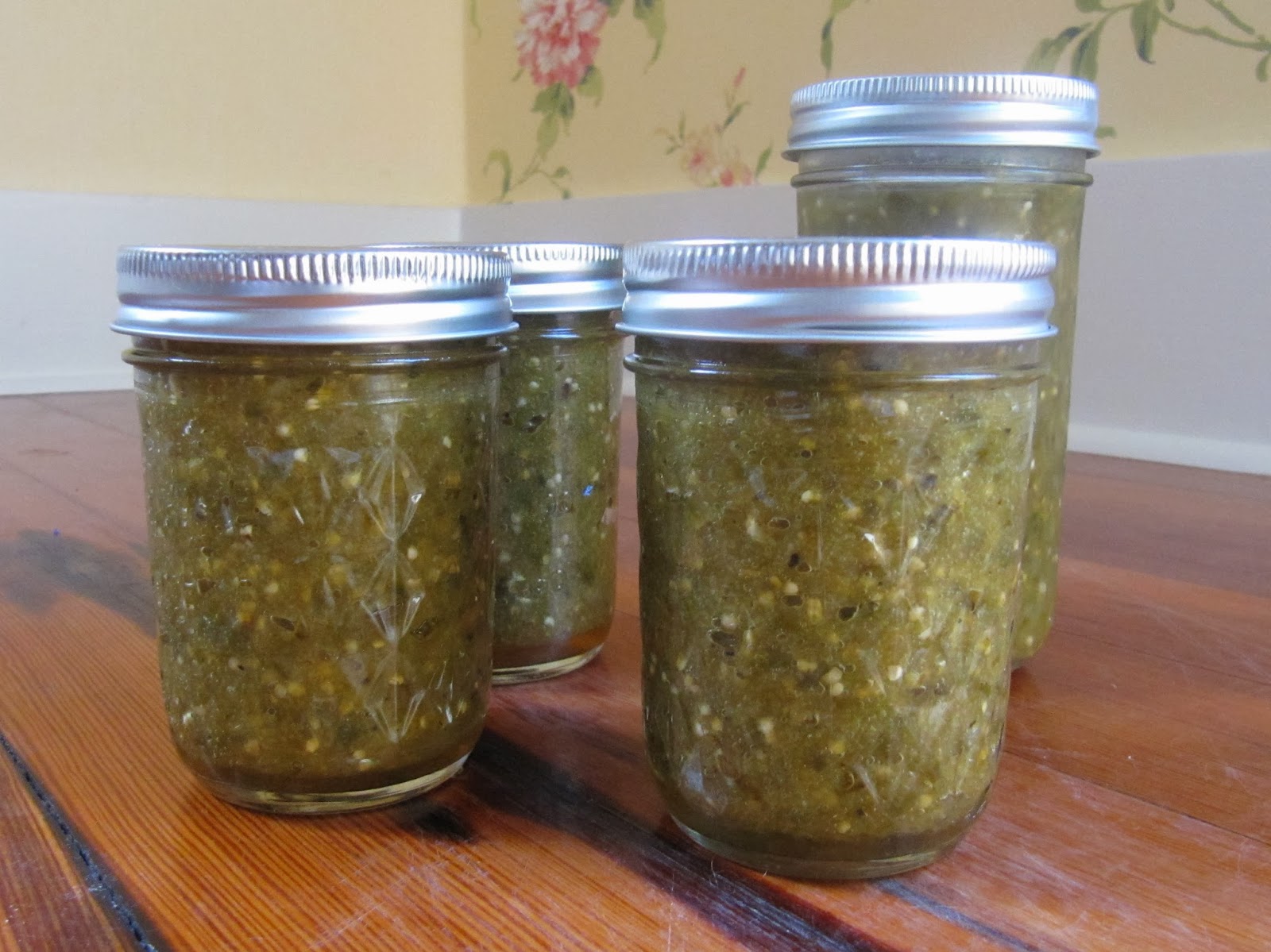
I was very excited to can a Salsa Verde (from Canning for a New Generation by Liana Krissoff) for green enchiladas. In the past I've purchased ingredients for the dish. Now not only will I have my own canned version, but this is one of the rare canning projects where I used my own produce rather than produce purchased from other farmers. The only other one I can think of is raspberry jelly.

Anyway, I was so excited I forgot to take photos through most of the process. But here's a description. After removing the husks, I put about 3 lbs tomatillos along with 4 jalapenos, a chunked onion, and peeled cloves of a head of garlic into a 500 degree F oven for 30 minutes. Everything came out collapsed, blackened in parts and a bit juicy. After the vegetables cooled, I put them in a pot along with 2/3 cup lime juice, one cup fresh cilantro and 1 tbsp salt. I mixed all that with my immersion blender, brought it back to a boil, put it in jars, and processed it in a hot water bath.

The result: 4 1/2 cups Salsa Verde.

The finished salsa has a very rich flavor from the roasting. It's also tangy from the lime juice and a little spicy. It should be perfect in the green enchilladas. It was great as a condiment on a spinach and broccoli frittata we had the other night too. That was a yummy way to use up the amount that didn't fit in the jars.

The other last garden chore before frost was to create a little window sill herb garden. I potted some thyme, parsley and sage from the garden in fresh soil. The pots will sit in a fish poaching pot I inherited from my grandmother's kitchen. In more than 20 years, I have NEVER used it to poach a fish. I'm glad I finally found a use for it.